 JOKERჯოკერი
The deck
36 cards: ranks 7–A in all four suits (32 cards) + 6♥ and 6♦ (only these two sixes) + 2 Jokers. 6♠ and 6♣ are not included. Rank order, low to high: 6 · 7 · 8 · 9 · 10 · J · Q · K · A. Jokers have no rank or suit of their own — their power depends entirely on how they're played.
Game structure
A full game consists of 4 pulkas, 24 rounds total.
| Pulka | Rounds | Cards per player |
|---|---|---|
| 1 | 8 | 1, 2, 3, 4, 5, 6, 7, 8 (ascending) |
| 2 | 4 | 9, 9, 9, 9 |
| 3 | 8 | 8, 7, 6, 5, 4, 3, 2, 1 (descending) |
| 4 | 4 | 9, 9, 9, 9 |
Before the first round the dealer is chosen by atuzva (ატუზვა): cards are dealt face up, one at a time around the table, until an ace appears — whoever gets it deals first. The dealer rotates clockwise after every round. The player immediately left of the dealer leads the first trick and, in 9-card rounds, chooses trump.
Dealing & trump
Normal rounds (1–8 cards)
- The dealer shuffles and deals the specified number of cards to each player.
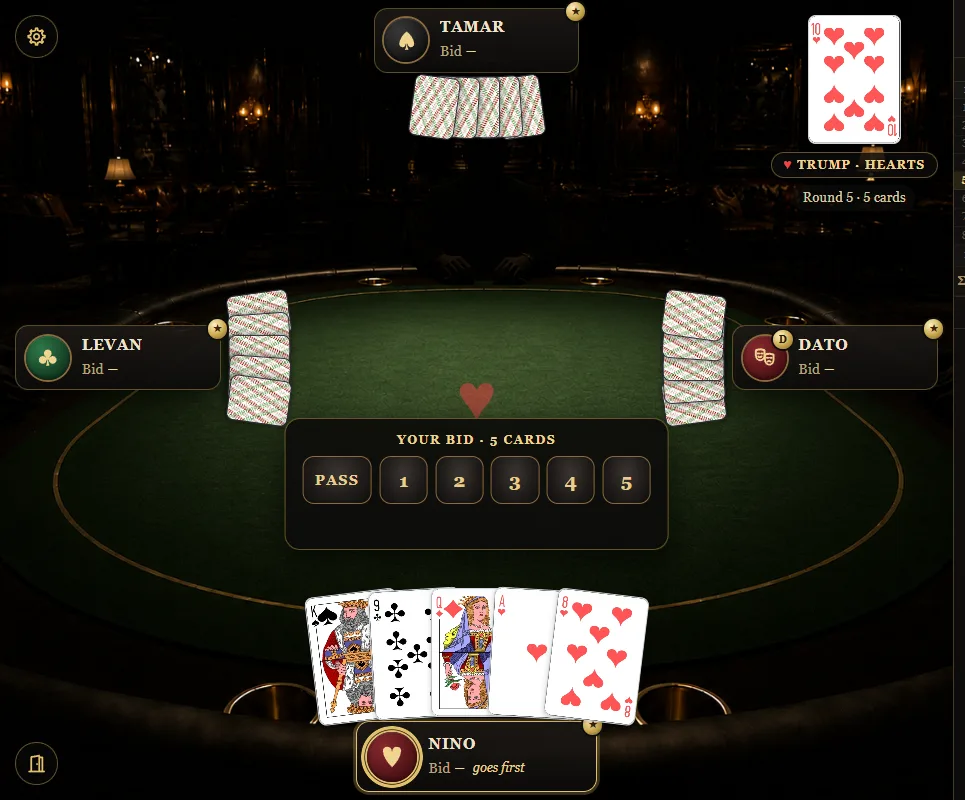
- The top card of the remaining deck is turned face-up — its suit is trump.
- If the top card is a Joker, the round is played with No Trump.
9-card rounds
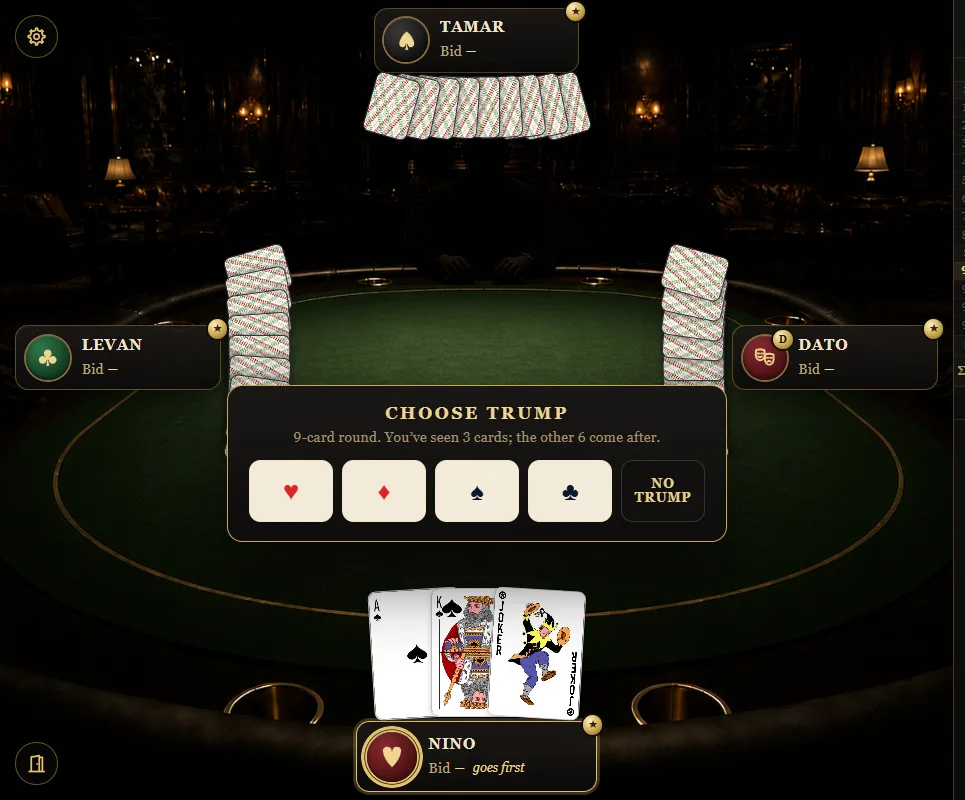
- The dealer deals 3 cards to each player.
- The player immediately left of the dealer looks at their 3 cards and freely chooses trump — any suit, or No Trump.
- Everyone receives their remaining 6 cards, then bidding begins.
This is our club's variant — many traditional versions just flip the next card for 9-card rounds too, same as a normal round. Free trump selection adds an extra layer of strategy here.
Bidding
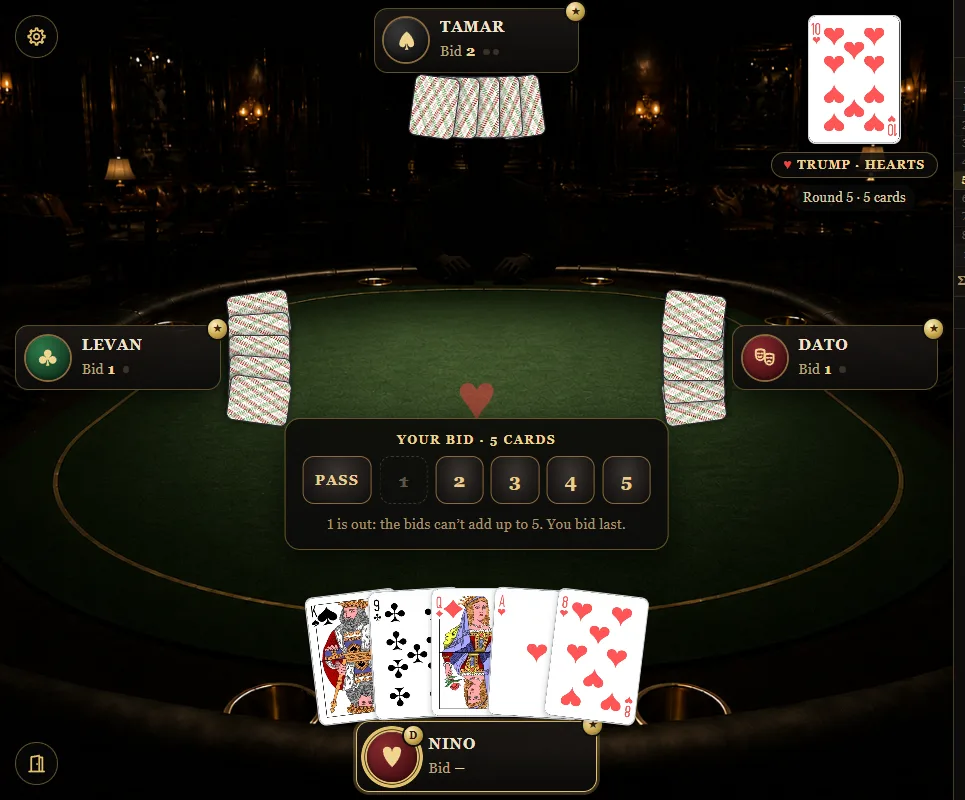
Starting from the player left of the dealer and going clockwise, each player bids how many tricks they expect to take this round.
Valid bids: 0 through the number of cards in the round.
Restriction: the last bidder (the dealer) cannot bid an amount that would make the total of all bids equal the number of tricks available. The total must be either over or under — a perfectly balanced table is forbidden.
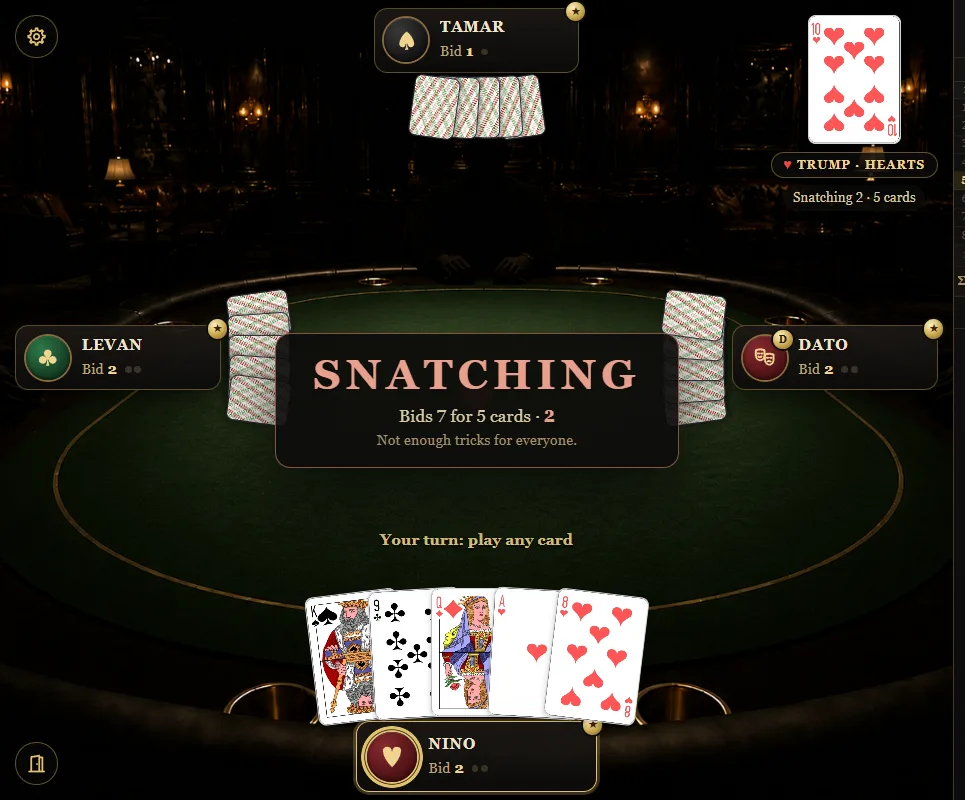
Once all bids are placed, the game announces whether the table is Shetenva (total bids < tricks available) or Tsaglejva (total bids > tricks available).
Playing tricks
The player left of the dealer leads the first trick. Thereafter, the winner of each trick leads the next.
Follow-suit rules
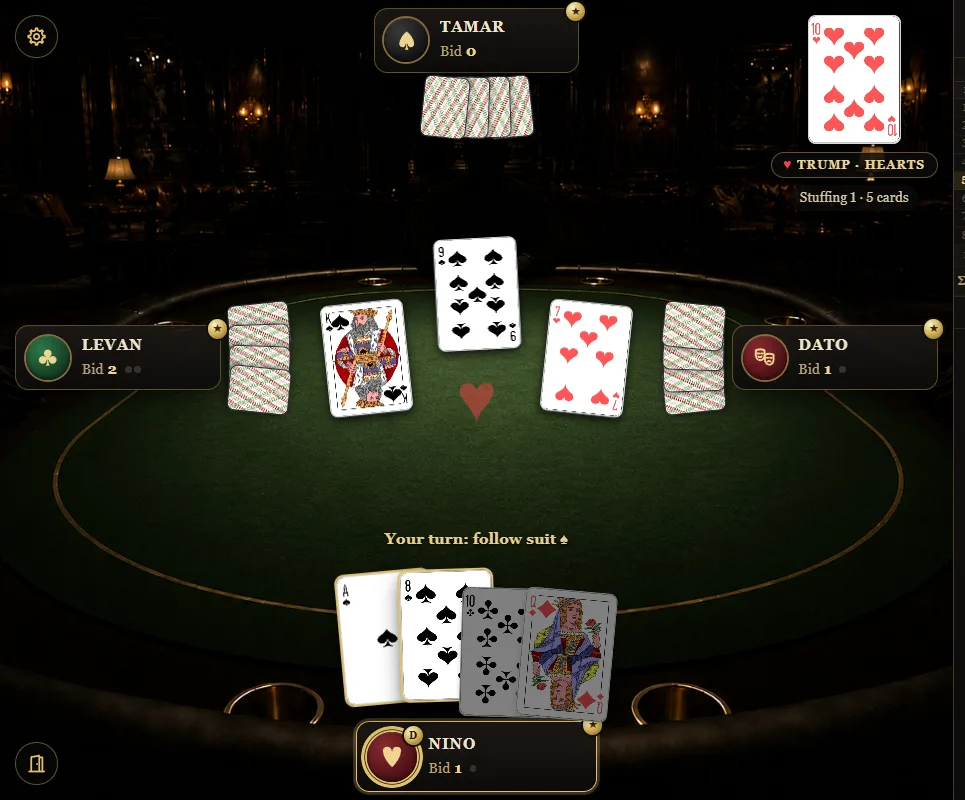
- Players must follow the led suit if they have it.
- If unable to follow suit, players must play trump if they have any.
- Only if a player has neither the led suit nor any trump may they play any card.
Winning a trick
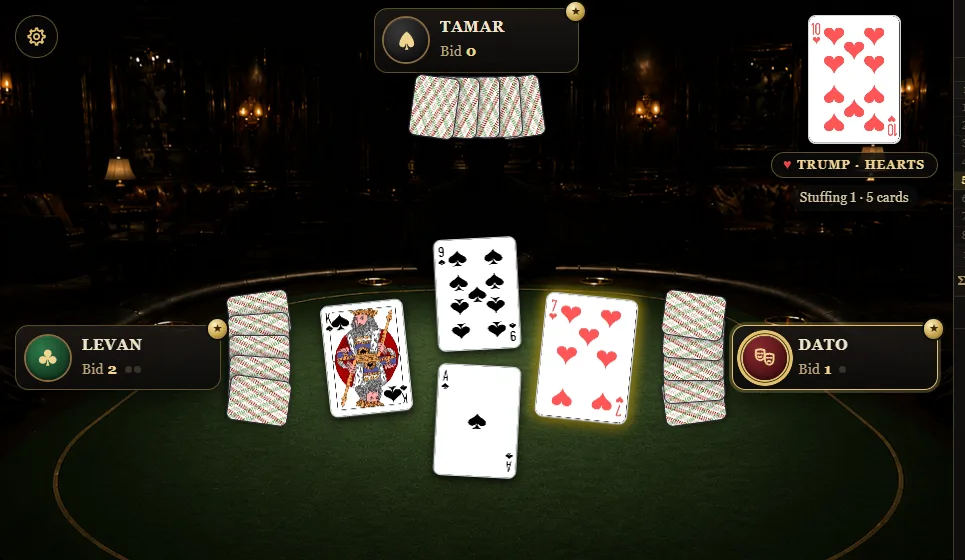
The trick is won by the highest trump played, or if no trump was played, by the highest card of the led suit.
Looking back
Once a trick is taken its cards are turned over. Only the last trick may be looked at again (the game shows it under the chat); earlier tricks have to be remembered.
The Joker
The Joker is the most powerful card in the game. It can be played at any time — even when you hold the led suit. A Joker has two modes: Senior (takes the trick) and Junior (gives it away). Trump rules apply as usual — which is why a Joker can lose to a plain trump if the wrong suit is named.
When the Joker leads the trick
| Call | What happens |
|---|---|
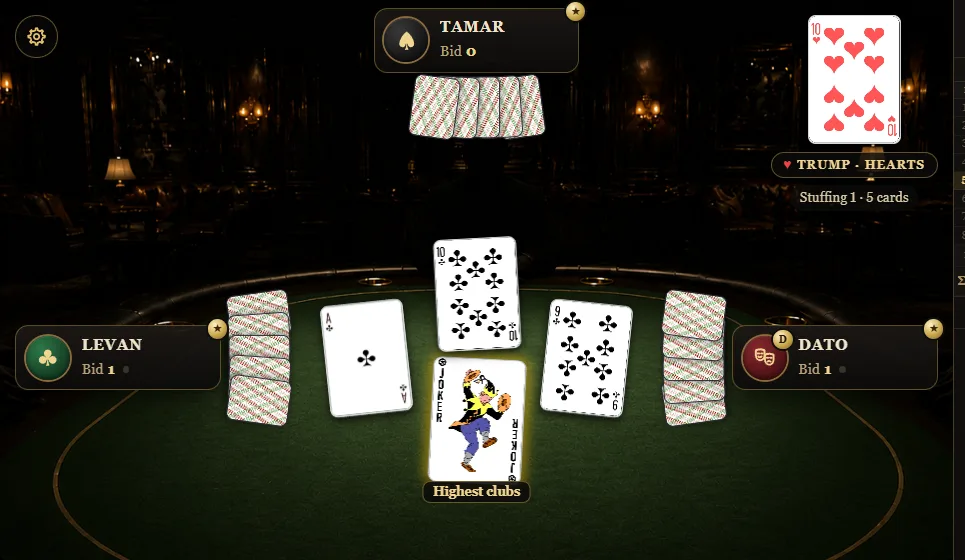
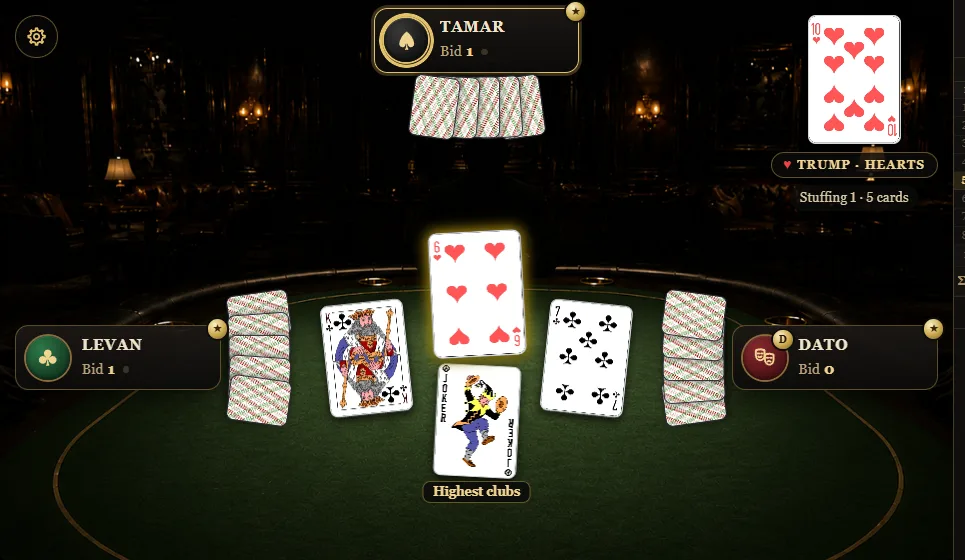
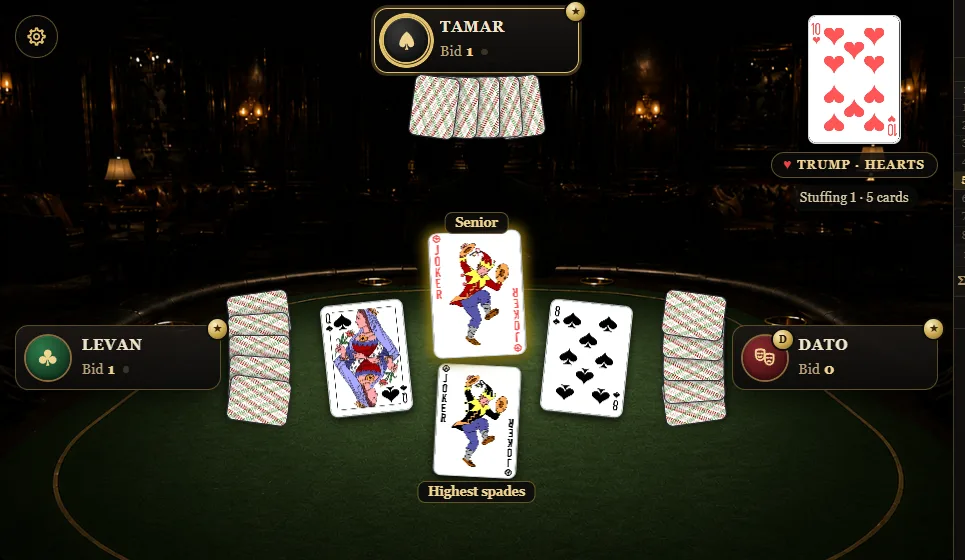
| Senior “Highest clubs” (or another suit) | The Joker is above the Ace of that suit (a “double Ace”). Everyone who holds the suit must play their highest card of it; anyone without it must play trump if able. The Joker takes the trick, with two exceptions: a Senior Joker played after it overrules it, or the named suit isn't trump and someone plays trump — then the highest trump wins. |
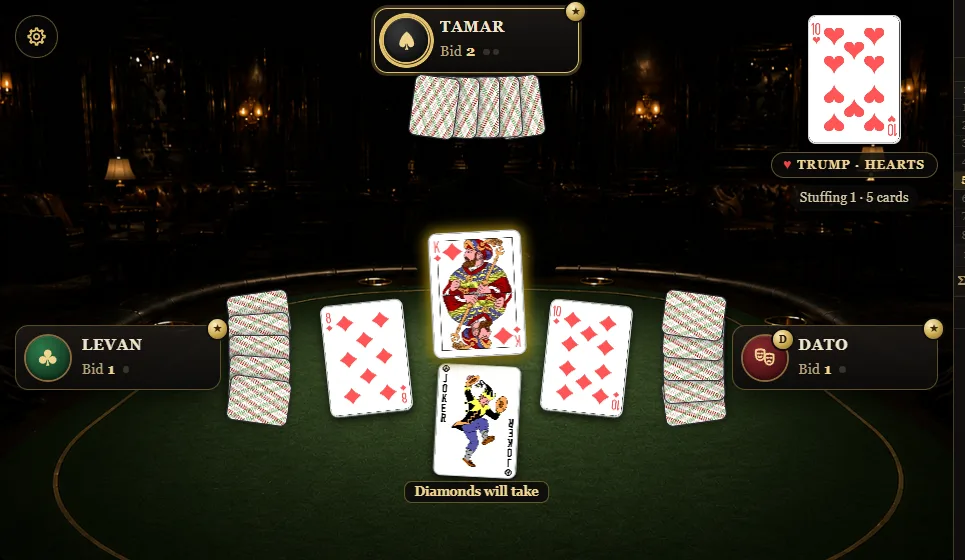
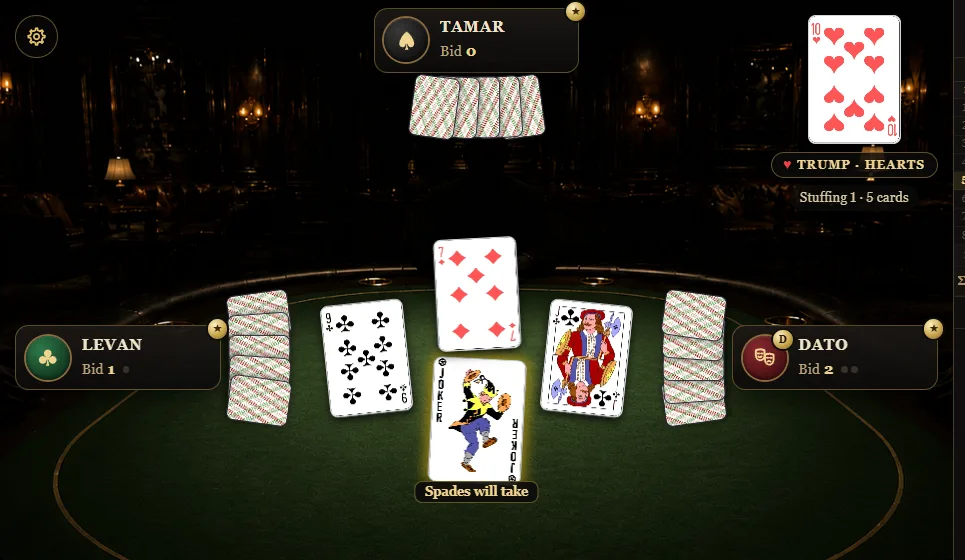
| Junior “Clubs will take” (or another suit) | The Joker is the lowest card of that suit (like a “2”). Everyone who holds the suit must follow it — with any card of it, neither highest nor lowest is required; anyone without it must play trump if able. The highest card of the suit, or a trump, takes the trick. If nobody can follow the suit, play trump or play a Senior Joker, the Joker takes the trick itself — there is simply no other card of that suit on the table. |
When the Joker is played 2nd, 3rd, or 4th
| Mode | What happens |
|---|---|
| Senior | The Joker takes the trick, whatever is on the table — unless another Joker is played after it as Senior: then the later Joker wins. |
| Junior | The Joker slides under the other cards: always the lowest, it gives the trick away. Useful for discarding without taking an unwanted trick. |
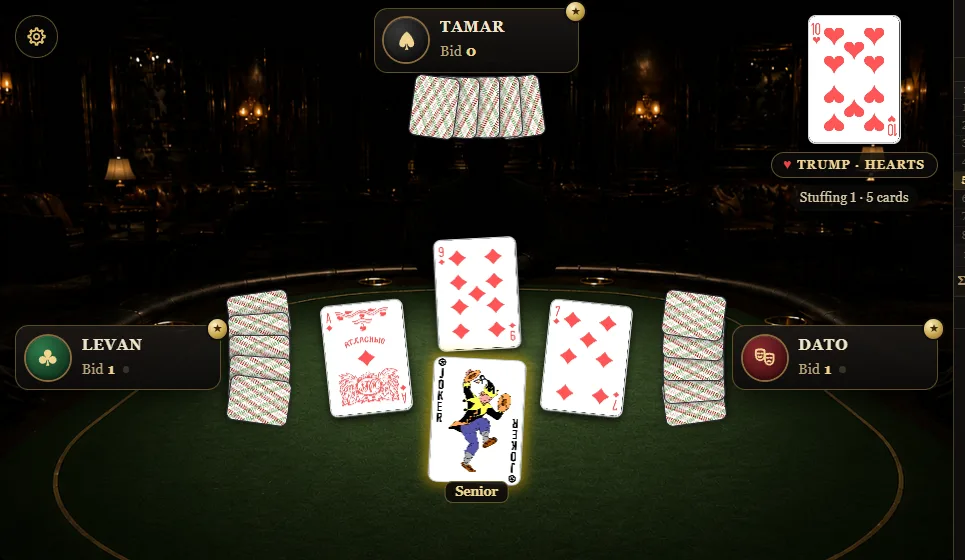
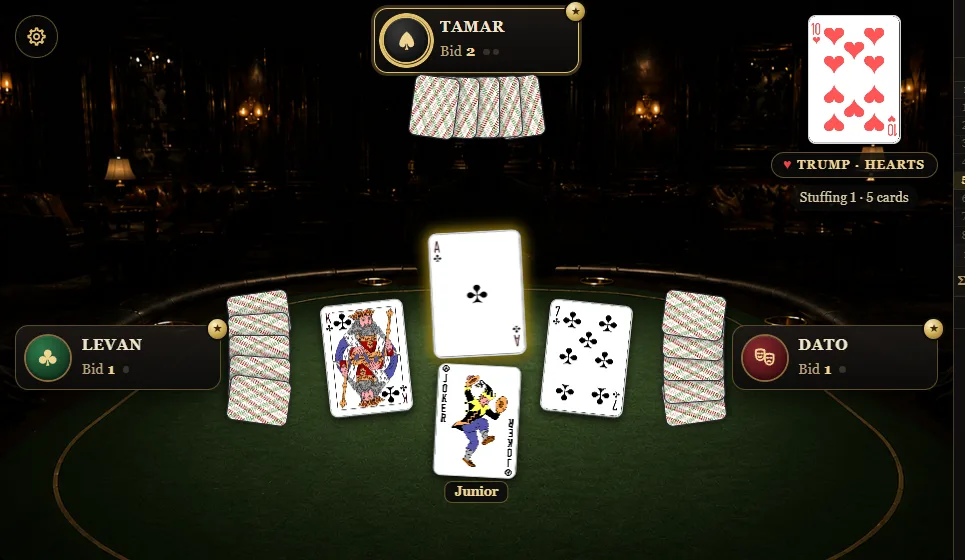
If both Jokers land in one trick, the last Senior Joker played wins; a Junior Joker always loses to any other card.
Scoring
| Bid | Tricks taken | Score |
|---|---|---|
| 0 | 0 | +50 |
| n | n (exact, not all tricks) | +50 + n×50 |
| n | n (exact, every trick in the round) | +n×100 |
| n > 0 | 0 (Hisht) | −hisht penalty |
| n | k, where k ≠ n (over or under) | +k×10 |
The last row applies in both directions — whether you took fewer tricks than you bid or more. Either way, the score is 10 × the actual number of tricks you took.
Hisht (ჰიშტი): bidding any positive number of tricks but winning zero. The penalty is configurable per room: Classic mode offers −200 · −500 · −200/−500 alternating by pulka · or dynamic ×100 (cards in round × 100). Default is −200.
Pulka bonus (premia)
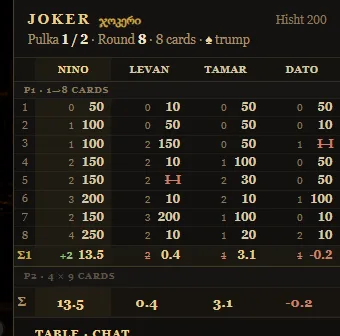
At the end of each pulka, a bonus or penalty is applied based on bid accuracy. A player is on premia if they hit their bid exactly in every round of the pulka.
- Premia winners receive a bonus equal to their own best single-round score.
- Everyone else loses that same amount — their own best round score (when Deductions is enabled, the default).
In Pairs mode: if your partner is on premia, you're exempt from the deduction; if players from different teams are simultaneously on premia, deductions cancel out for everyone.
At the table, a small ★ coin next to each player's name shows it: gold while the player is still on premia, struck through once one of their bids in this pulka has missed (off premia).
Room settings
The room host can configure: game mode (Classic 24-round, or Only 9 — every round uses 9 cards), the hisht penalty size, Play in Pairs (P1+P3 vs P2+P4), and deduction options.
Club variants
Joker is played a little differently from one table to the next. jokeri.pw follows two rules common in Georgian clubs:
- In 9-card rounds trump is chosen, not turned up. The player left of the dealer looks at their first 3 cards and names trump: any suit, or no trump. Some tables turn up the next card in these rounds too, as in the shorter ones.
- A premia costs the others. When a player earns the premia, everyone else loses their own best round of that pulka. This can be turned off in the room settings (Deductions).